Most cinnamon sold in American grocery stores isn’t actually cinnamon — at least not the plant that first earned the name. It’s cassia, a related but botanically distinct spice, sold under the generic label “cinnamon” because US labeling law doesn’t require the two to be distinguished. If you’ve only ever cooked with the reddish-brown, single-thick-curl sticks from a supermarket spice aisle, you’ve almost certainly never tasted true Ceylon cinnamon. Here’s the real difference, and why it’s worth caring about.
Two different plants, both called “cinnamon”
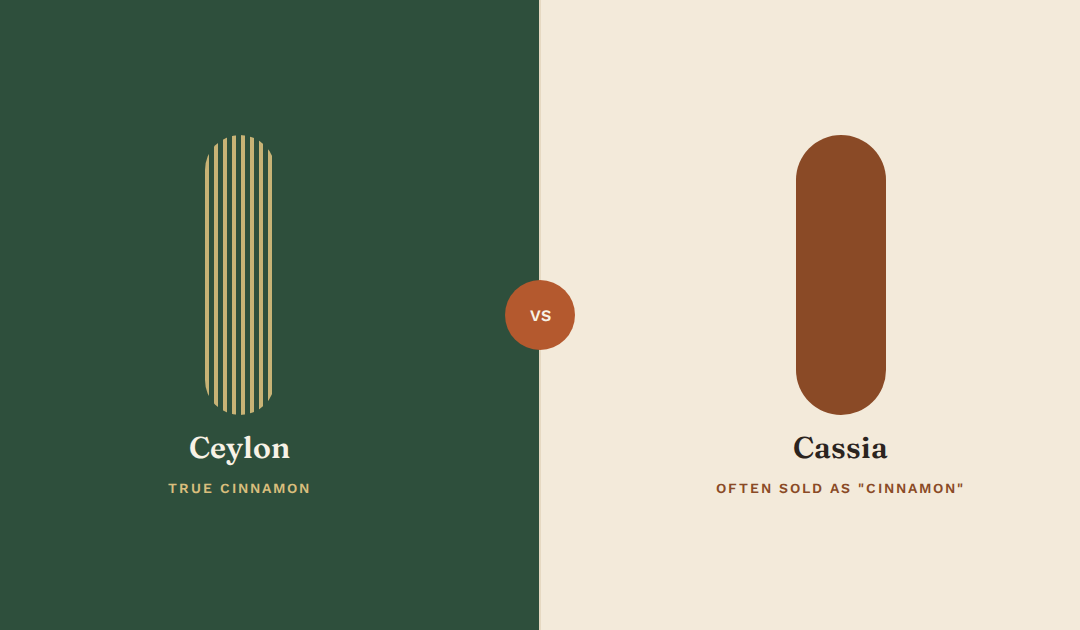
“True” or Ceylon cinnamon comes from the inner bark of Cinnamomum zeylanicum (also called Cinnamomum verum), a tree native to Sri Lanka — the island once known as Ceylon, which still produces the large majority of the world’s true cinnamon supply. Cassia, by contrast, usually comes from Cinnamomum cassia (also called Cinnamomum aromaticum), grown mainly in China, Indonesia, and Vietnam.
They’re cousins, not the same plant, and the differences show up clearly once you know what to look for:
- Shape: Ceylon cinnamon bark is thin and peels in multiple soft layers, so a quill rolls up looking like a tightly furled cigar with many visible layers. Cassia bark is thick and stiff, so it curls into a single, hard roll from both edges toward the center.
- Color: Ceylon cinnamon is a lighter tan-brown. Cassia is a darker, more reddish-brown.
- Texture: Ceylon quills are light and brittle enough to crumble or snap by hand. Cassia sticks are hard and woody — you generally need a grinder, not your fingers.
- Flavor: Ceylon cinnamon is delicate, slightly sweet, with citrus and floral notes. Cassia is more one-dimensional: a stronger, hotter, more straightforwardly “spicy” flavor, which is part of why it’s the default in many commercial baked goods — it reads as “more cinnamon flavor” in a crowd, even though it’s a different, blunter flavor.
The coumarin difference: why this isn’t just a flavor preference
The more important difference is one you can’t see or taste: coumarin, a naturally occurring compound both species contain, but in very different amounts. Cassia cinnamon contains substantially more coumarin than Ceylon cinnamon — published lab analyses have found the gap to run into multiple orders of magnitude between the two.
Why it matters: the European Food Safety Authority (EFSA) has set a tolerable daily intake (TDI) for coumarin of 0.1 mg per kilogram of body weight, because high cumulative coumarin intake has been linked to liver effects in sensitive individuals. For an average adult, that TDI is not hard to reach with cassia — some published estimates put a single teaspoon of cassia cinnamon well into or past that daily limit, especially for people who use it generously or every day (in coffee, oatmeal, baking, or supplements). Ceylon cinnamon’s coumarin level is low enough that reaching the same limit from Ceylon alone would take a much larger, less realistic amount.
To be clear about what this does and doesn’t mean: occasional cassia cinnamon in food is not considered dangerous for most people, and published coumarin figures vary somewhat by source and by batch. But if you use cinnamon daily — stirred into coffee or oatmeal every morning, for example, or taken as a supplement for blood-sugar support — the species you’re using stops being a minor detail. Ceylon cinnamon is the version that lets you use it generously and daily without the coumarin math working against you.
Why “cinnamon” on a label doesn’t tell you which one you’re getting
In the United States, food labeling law allows both Ceylon and cassia to be sold simply as “cinnamon,” with no requirement to specify the species. In practice, the overwhelming majority of ground cinnamon sold in US grocery stores — and most “cinnamon sticks” too — is cassia, because it’s cheaper to grow and produces a thicker, higher-yield stick. Genuine Ceylon cinnamon almost always has to be labeled as such specifically, because it costs more to produce and sellers want credit for it.
That’s exactly why our packaging says “Authentic” and “Ceylon Cinnamon” explicitly, not just “cinnamon” — and why our cinnamon sticks and cinnamon powder are graded and labeled with their real Sri Lankan quill grade (see our guide to what C5 and C4 grading actually means), not a vague, unverifiable “premium” claim.
How to tell them apart at home
If you already have cinnamon sticks in your pantry, you can usually tell which one you have without a lab:
- Look at the roll. Many thin layers rolled from both sides = Ceylon. One thick, hard single curl = cassia.
- Try to snap it. Ceylon is light and brittle. Cassia is hard and woody and will barely bend.
- Check the color. Ceylon is a lighter tan. Cassia is a deeper reddish-brown.
- Read the label carefully. If it just says “cinnamon” with no species named, assume cassia unless “Ceylon” or Cinnamomum zeylanicum/verum is stated explicitly.
Shop the real thing


Frequently asked questions
Is Ceylon cinnamon just a marketing term, or a real botanical difference?
It’s a real, distinct species — Cinnamomum zeylanicum (syn. Cinnamomum verum) — different from the cassia species (Cinnamomum cassia/aromaticum) used in most grocery-store cinnamon. The difference is botanical, not just branding.
Is cassia cinnamon unsafe?
Occasional use in food is not considered a significant risk for most healthy adults. The concern is cumulative, regular, high intake — daily use over a long period — because of cassia’s much higher coumarin content relative to the EFSA tolerable daily intake. People who use cinnamon daily, in large amounts, or as a supplement are the ones who benefit most from switching to Ceylon.
Why does cassia cinnamon taste “stronger”?
Cassia’s flavor compounds are more concentrated and one-note, reading as a stronger, hotter cinnamon taste. Ceylon cinnamon is more delicate and layered, with mild sweet and citrus notes — a different flavor profile, not simply a weaker version of cassia.
How can I be sure I’m buying real Ceylon cinnamon?
Look for the species named explicitly (Ceylon, Cinnamomum zeylanicum, or Cinnamomum verum) and, ideally, an actual Sri Lankan grade marking like C5 or C4 — not just the word “premium” or “pure” on its own.
See Ceylon cinnamon in the press → real video and news coverage of Sri Lanka’s cinnamon growers and the hand-peeling process behind every quill.